
How to Get Backlink Through Quality Directory Submissions in 2024
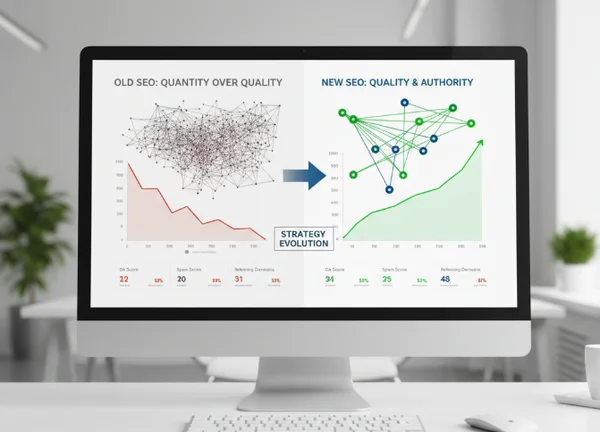
For many years, SEO professionals debated whether directory submissions were still useful. In the early days of the internet, you could submit your site to thousands of directories and see your rankings climb. Today, the landscape is very different. Search engines like Google have become much smarter. They no longer reward bulk submissions. Instead, they focus on the relevance and authority of the sites linking to you.
Are you still using old directory submission methods that could hurt your rankings?
Let's explore how directory submissions fit into today's SEO landscape. You will learn how to shift your focus from mass submissions to a strategic, quality-first approach. We will show you how to find the right directories and how to use modern tools to stay ahead. If you want to save time while improving your SEO, you can try our free tool to start building better links today.
Why Quality Directory Submissions Still Matter in 2024
Directory submissions are often misunderstood. While some call them an "old school" tactic, they remain a foundational part of a healthy backlink profile. The trick is recognizing that directory submissions have transformed over time. They are no longer about tricking an algorithm; they are about establishing your digital presence.
Understanding the Evolving Value of Directory Backlinks
In 2024, a directory backlink serves as a "trust signal." When a reputable, moderated directory lists your website, it tells search engines that your business is legitimate. These links help establish your "NAP" consistency (Name, Address, Phone number). Consistency across the web is a major ranking factor for local SEO.
Furthermore, directory listings can drive actual referral traffic. If someone is looking for a specific service in a niche directory, they are a high-intent user. Getting a link from a well-trafficked directory is not just about SEO. It is about being where your customers are looking.
How Google Views Quality Directory Backlinks in Post-2023 Updates
Google’s recent core updates and "SpamBrain" AI are designed to ignore low-quality links. Google typically ignores links from "link farm" directories that exist only to sell links. In extreme cases, too many poor-quality backlinks can even trigger a manual review or cause your rankings to drop.
However, Google still values editorial integrity. A directory that requires a manual review process is seen as much more valuable. When a human editor checks your submission, it adds a layer of "Expertise, Authoritativeness, and Trustworthiness" (E-E-A-T). To make sure you are following the best path, you can use our smart tool to identify safe and effective submission opportunities.
Identifying High-Quality Directories for Your Backlink Strategy
Not all directories are created equal. Spending your time on the wrong sites is a waste of resources. You need to be selective about where you place your brand.
Key Metrics for Evaluating Directory Quality
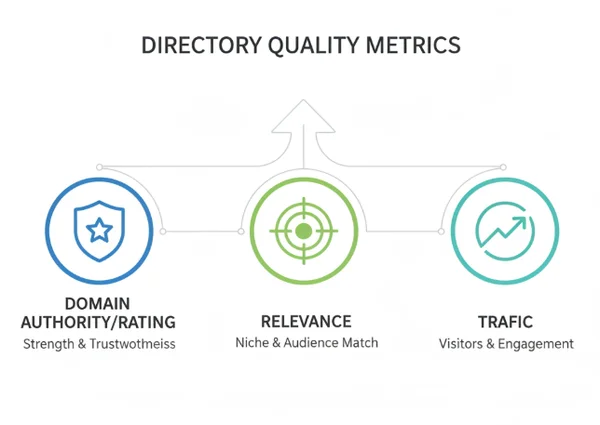
Before submitting your site, look at these three main factors:
-
Domain Authority (DA) or Rating (DR): While not perfect, these scores give you an idea of the site's overall strength. Aim for directories with a solid history.
-
Relevance: Does the directory cover your industry or location? A link from a local Chamber of Commerce is often worth more than a link from a generic global directory.
-
Traffic: Use tools to see if the directory actually gets visitors. If no one visits the site, the link has less value.
Niche vs. General Directories: Where to Focus Your Efforts
General directories like Yelp or Yellow Pages are essential for broad visibility. However, niche directories are where the real SEO magic happens. If you are a lawyer, being listed on a legal-specific directory carries immense weight. These sites have high topical authority.
Search engines see a link from a niche site as a strong endorsement of your expertise in that specific field. We recommend a balanced approach. Get the "big" general links first, then go deep into your niche.
Red Flags: Spotting Low-Quality Directories to Avoid
Be careful of directories that look like they were made in the 1990s and haven't been updated. Here are some warning signs:
- Instant Approval: If they don't check your site, they probably don't check anyone else's. This leads to a neighborhood of spam.
- Excessive Ads: If the directory is covered in pop-ups and flashy ads, its primary goal is ad revenue, not providing value.
- No "About" or "Contact" Page: Real businesses have real people behind them. If you can't find out who runs the directory, stay away.
Crafting Compelling Directory Submissions That Get Approved
Getting listed is not guaranteed. High-quality directories have editors who reject poor-quality submissions every day. You need to treat every submission like a mini-marketing campaign.
Writing Irresistible Business Descriptions for Directories
Do not copy and paste the same 50-word paragraph into every directory. This creates "duplicate content" issues. Instead, write unique descriptions that highlight your unique selling points.
- Focus on Benefits: Tell the reader what problem you solve.
- Use Keywords Naturally: Include your primary keywords, but don't "stuff" them.
- Be Concise: Editors appreciate clarity.
Category Selection Strategies for Maximum Impact
Choosing the wrong category is a common mistake. If you are a "Web Design Agency," don't just list yourself under "Computers." Look for "Marketing > Digital Marketing > Web Design." The deeper and more accurate the category, the more relevant the backlink becomes. If you are unsure which category fits best, explore our platform for guidance on optimized submission structures.
Optimizing Contact Information and Business Details
Consistency is king. Ensure your business name, address, and phone number are identical across all platforms. Even small differences, like "Street" versus "St.", can confuse search engine crawlers. Always include a link to your most important page—usually your homepage—and double-check that the URL works correctly.
Leveraging AI for Strategic Directory Submissions
Modern SEO is fast-paced. Doing everything manually can take hundreds of hours. This is where Artificial Intelligence (AI) becomes your best friend.

How AI Enhances Directory Relevance and Personalization
AI can rewrite your business descriptions for each directory submission. This creates unique content for every directory, which Google appreciates. Our AI at Get Backlink can analyze your website and generate personalized descriptions. These match the tone and requirements of different directories automatically.
Automated vs. Manual Directory Submissions: Finding the Right Balance
Manual submission offers accuracy but is time-consuming. Complete automation might be fast but carries risks. The ideal solution is "AI-accelerated" submission, where tools help with resource discovery and form completion while you maintain quality control. By using a browser plugin for SEO, you can automate the boring parts of form filling while ensuring the quality remains high.
Quality Control Framework for Automated Directory Submissions
Even with AI, you must have a quality control process. Always review the list of directories before the tool starts the submission. Make sure the AI-generated text sounds human and helpful. A good framework involves:
- Filtering: Selecting only high-DR and relevant sites.
- Reviewing: Checking the AI's output for accuracy.
- Monitoring: Tracking which submissions were accepted and which were not.
Measuring and Scaling Your Backlink Results from Directories
To see what's working, you need to track your results. Once you start your campaign, you need to monitor your progress effectively.
Tracking Directory Submissions and Their Impact
Keep a record of every directory you submit to, the date of submission, and the status. Over time, monitor your search engine rankings for your target keywords. You should also check your Google Search Console. This helps you see when these new backlinks start appearing in your profile.
Building a Sustainable Directory Submission Workflow
Don't try to submit to 500 directories in one week. This looks unnatural to search engines. Instead, aim for a steady "drip" of submissions. Maybe 10 to 20 high-quality listings per month is a better goal for a new website. This sustainable pace builds a natural-looking link profile that gains trust over time.
From Individual Efforts to Team Directory Building for Agencies
If you are a marketing agency, managing directory submissions for 20 different clients is a massive task. You need a centralized system. A SaaS platform allows your team to collaborate, share successful directory lists, and track results across multiple projects. This is the most efficient way to scale your services without losing quality. To see how your team can work faster, check out our service for professional SEOs.
Final Thoughts: Your Path to Quality Directory Backlinks in 2024
Directory submissions remain valuable in 2024—when done right. Focus on quality, not quantity. By choosing high-authority sites, writing unique descriptions, and leveraging AI for efficiency, you can build a strong SEO foundation that lasts.
Stop wasting time on manual data entry and low-quality lists. Focus on strategic growth and let technology handle the heavy lifting. If you are ready to boost your SEO with the smartest tools available, start your journey on our homepage and download the free plugin today.
Frequently Asked Questions About Directory Submissions
How many directory submissions should I make per month?
For a new website, we recommend between 10 and 20 high-quality submissions per month. The goal is "natural growth." If you suddenly get 200 links in one day, it might look like spam to Google. Consistency is more important than speed. You can get started for free to manage your monthly pace easily.
Are free directory submissions as effective as paid ones?
Free submissions can be effective if the directory is well-moderated. However, paid directories often have higher standards and human editors. Because they charge a fee, they tend to have fewer spammy neighbors. Both have a place in a balanced strategy, but always check the site's quality first.
Can directory submissions hurt my SEO if done incorrectly?
Yes. If you submit to "toxic" or "spammy" directories that are part of a link farm, Google may penalize your site. Always avoid directories that promise "thousands of links for $5." Quality over quantity is the only safe way to build links in 2024.
How long does it take for directory backlinks to impact my rankings?
It usually takes between 4 to 12 weeks for search engines to crawl a new directory listing and factor it into your rankings. SEO is a long-term game. Be patient and keep building high-quality links consistently.
What's the best approach for directory submissions in competitive niches?
In highly competitive niches, general directories aren't enough. You must find industry-specific directories and local listings. Focus on sites that require business verification. These "hard-to-get" links are the ones that will actually move the needle for your rankings. Using an AI-powered assistant can help you find these hidden opportunities faster than your competitors.